Ajay Kumar
Quick answer: how is AI used in advertising today?
In 2026, AI on Meta and Google chooses audiences, sets bids, decides placements, shifts budgets and generates ad variations automatically. Meta's Advantage+ and Google's AI Max and Performance Max are the main examples. Humans still decide the strategy, offer, brand message, profit targets and what data the AI optimises for - and those decisions now matter more than manual settings.
Five years ago, running ads well meant building dozens of interest audiences, adjusting bids by hand every morning and testing placements one by one. In 2026, most of that is done by AI inside Meta and Google - often better than a person could do it.
That doesn't mean advertising got easy. It means the skills that matter have changed. This guide explains what AI now does in your ad accounts, where it goes wrong, and how to stay in control.
What AI now does in Meta and Google Ads
1. Finds your audience
Instead of you choosing interests, Meta's Advantage+ audience and Google's broad matching and Performance Max use signals from millions of users to find people likely to convert. Meta's newer ad retrieval system, known as Andromeda, matches individual ads to individual people more precisely than before.
2. Sets bids and budgets
Smart bidding on Google and Meta's bid strategies adjust what you pay in every single auction, based on how likely that person is to convert. Campaign-level budgets move money between ad sets automatically.
3. Chooses placements and channels
Advantage+ placements spread ads across Facebook, Instagram, Reels and more. Performance Max decides between Search, Shopping, YouTube, Display, Discover, Gmail and Maps.
4. Creates ad variations
Both platforms now generate text variations, adjust images and assemble ads from your assets. Google's AI Max for Search can tailor ad text to each search and pick the best landing page on your site.
5. Fills measurement gaps
With privacy changes limiting tracking, platforms use modelled conversions to estimate results they can't directly observe - another reason to send good first-party data through the Conversions API and enhanced conversions.
Where AI still gets it wrong
It optimises for what you tell it - even if that's the wrong thing
If you optimise for clicks, AI finds clickers. If you optimise for purchases, it finds purchases - including low-margin or likely-to-be-returned ones. It doesn't know your product cost, shipping, returns or RTO (COD orders that come back, common in India and the Gulf) unless you tell it. That is why a 3x ROAS can still lose money.
It spends on irrelevant traffic when unchecked
Broad matching and Performance Max can show your ads on searches you never wanted. Weekly negative keyword reviews and brand exclusions are essential.
It needs data to learn
New accounts with few conversions or broken tracking give AI nothing to learn from. Results are erratic until the data improves.
It can't create your strategy
AI doesn't decide your price, your offer, which product to push this month or how your brand should sound. Those decisions now have the biggest impact on results.
Your new job: inputs and guardrails
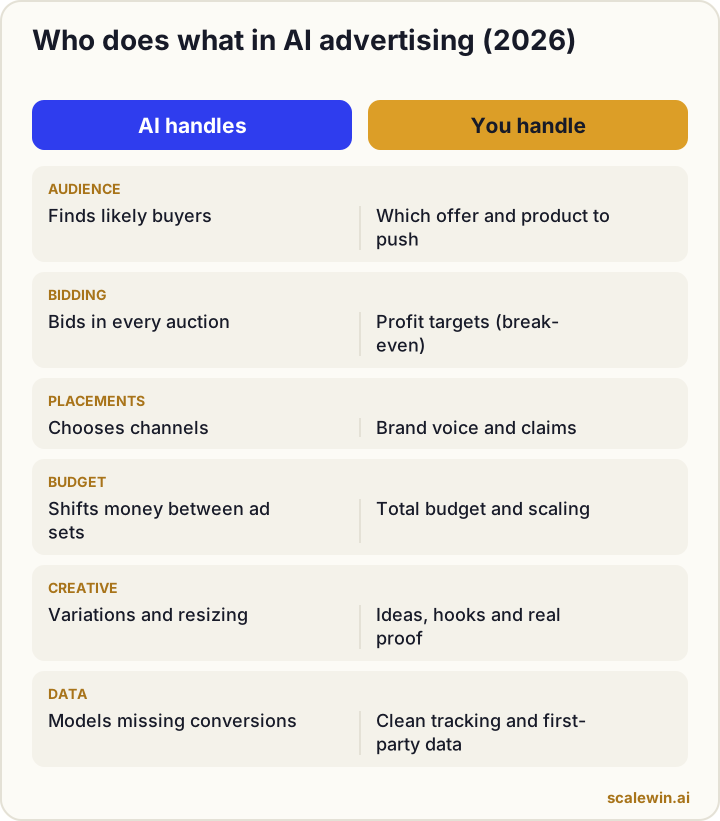
| AI handles | You handle |
|---|---|
| Who sees the ad | Which offer and product to promote |
| Bid in every auction | Profit targets (break-even CPA / ROAS) |
| Placement and channel mix | Creative ideas, hooks and proof |
| Budget shifts between ad sets | Total budget and when to scale |
| Text and image variations | Brand voice, claims and policy compliance |
| Modelled conversions | Clean tracking and first-party data |
How to use AI advertising safely: a checklist
- Fix tracking first - Meta Pixel plus Conversions API, Google enhanced conversions. See our Pixel and CAPI guide.
- Optimise for the right event - purchases or qualified leads, never just clicks.
- Set profit-based targets using your break-even ROAS.
- Feed it creative variety - several genuinely different ads, refreshed regularly.
- Add guardrails - negative keywords, brand exclusions, budget limits.
- Review weekly - search terms, placements, cost per result vs break-even.
The next step: AI agents
Platform AI optimises inside each platform. The newest tools - AI agents - sit on top of several platforms and act like a full-time performance marketer: reading results across Meta and Google every day, pausing losers, scaling winners and shifting budget between platforms, within limits you approve. For a comparison of the options, see our guide to the best AI tools for ads.
What to look for in an AI agent
Questions to ask before you trust one
- Does it optimise on profit, using your real costs?
Control and transparency
Change history
- Can you see every change it made, and why?
Spending and change limits
- Can you set limits on budgets and changes?
Platform coverage
- Does it cover all the platforms you use?
The bottom line
AI didn't make advertising automatic - it made the inputs more important. Give it the right goal, clean data and strong creative, and it will outperform manual management. Give it the wrong goal and it will efficiently waste your money.
Key takeaways
- AI now handles targeting, bidding, placements, budget shifts and creative variations.
- Your job has moved to inputs: offer, creative ideas, conversion data and profit targets.
- AI optimises for whatever you measure - so measure profit, not clicks.
- Add guardrails: negative keywords, brand exclusions, budget caps and regular reviews.
- AI agents can now run daily optimisation end to end, within the limits you set.
AI in advertising: frequently asked questions
Will AI replace digital marketers?
Is AI targeting better than manual targeting?
Can AI write and design my ads?
What are the risks of AI advertising?
Do ads appear in Google's AI Overviews?

Ajay is the founder of ScaleWin. He works hands-on with Meta Ads, Google Ads and SEO for Indian D2C and service brands, and built ScaleWin so that the daily work of a performance marketer - reading numbers, pausing losers, scaling winners - happens automatically.
Drafted with AI assistance. How these articles are written
Put an AI agent on your ad accounts
ScaleWin's AI runs your Meta Ads, Google Ads and SEO daily, decides on profit and tells you everything it did on WhatsApp.
Start your 3-day free trial