Ajay Kumar
Quick answer: what is an AI Meta ads tool, and do you need one in 2026?
An AI Meta ads tool is software that uses AI to create, run, analyse or report on Facebook and Instagram ads. In 2026, Meta's free Advantage+ and its official AI Connectors already handle targeting, placements, basic creative and agent-style changes. Pay only for the gaps: creative volume, independent measurement, guardrails and cross-channel reporting.
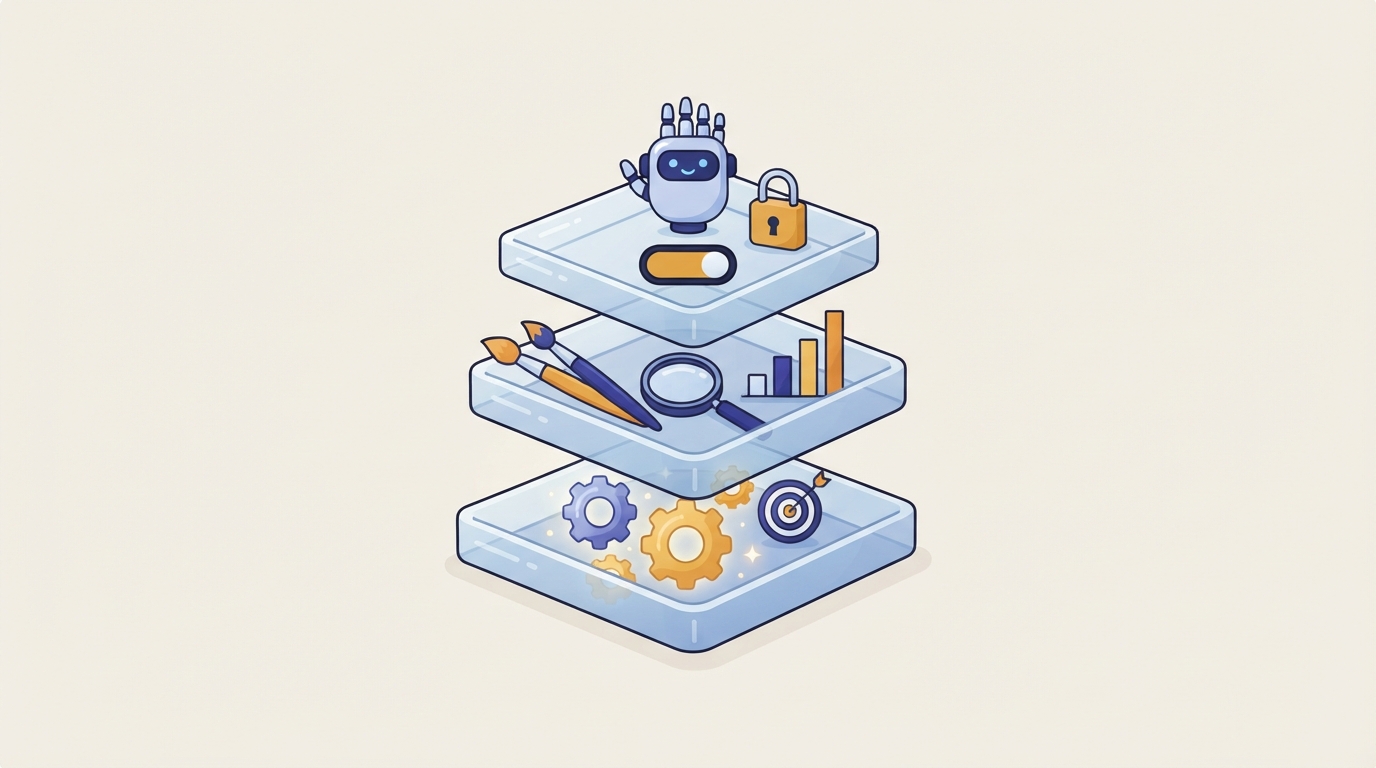
Three layers of AI now sit inside every Meta account
An 'AI tool for Meta ads' can mean three very different things in 2026. Knowing which layer you are buying stops you paying twice for the same job.
- Meta's native AI: Advantage+ campaigns, the Andromeda ad-retrieval system, Advantage+ creative and the new Ads Creative Studio. This layer is free, and it runs inside every account whether you use it on purpose or not.
- Third-party tools: creative generators, creative analytics, rules engines, attribution platforms and enterprise suites. These sit on top of Meta's AI and can only steer it, never replace it.
- AI agents and connectors: assistants that read and change your account through plain-language requests. Meta now offers an official version of this layer, reported to be free during its beta.
Why the ranking pages disagree with each other
Almost every 'best AI tools for Meta ads' page you will find is written by a tool vendor, and each one ranks itself first. Some even put Advantage+ last, though it runs underneath every tool on their list.
This guide takes the opposite route. We start with what Meta already does for free, then look at where a paid tool still earns its fee. For a tool-by-tool breakdown, see our comparison of AI Meta ads tools for creative, optimisation and reporting.
Who this guide is for
It is written for D2C, Shopify, service and lead-generation brands, and the agencies that run them, spending ₹10 lakh to several crore a month. At that level a wrong tool choice costs real money. So does a bad setting that Meta switched on by default.
Meta's free AI already runs targeting, placements and much of your creative
Before you compare paid tools, accept the baseline. Meta's own AI now makes most targeting and delivery decisions, and several of those settings are switched on by default.
Advantage+ sales campaigns replaced Advantage+ shopping
Meta renamed Advantage+ shopping campaigns to Advantage+ sales campaigns. Secondary sources date the change to 6 February 2025. Any tool or guide that still says 'ASC' is working from old information. Since Marketing API v25.0 (18 February 2026), legacy ASC and AAC campaigns can no longer be created or updated through the API.
The new format works differently:
- Ad sets are back. Secondary sources report each is capped at 50 ads, replacing the old limit of 150 ads per campaign; we could not confirm this from Meta.
- Secondary sources report that audience exclusions are generally allowed at ad-set level, and Marketing API deprecation coverage says the separate existing-customer budget cap has been removed.
- A Sales, App or Leads campaign counts as 'Advantage+ on' only when budget, audience and placements are all set to Advantage+.
Meta claims advertisers using Advantage+ targeting see 22% higher returns than those who do not. That is Meta's own figure, so treat it as a claim to test, not a promise.
Defaults you no longer fully control
Several changes in 2026 took decisions out of your hands. Any tool you add has to work around them:
- Placements: a Meta Help Center page, flagged in the trade press on 12 October 2026, says Sales, Leads, Engagement and App campaigns no longer allow manual placement choice at ad-set level. Meta says this is rolling out gradually. Awareness and Traffic still do.
- Excluded placements: where ad-set exclusions remain, industry reports say Meta may spend up to about 5% of budget on an excluded placement unless you untick that allowance. We could not confirm the figure from Meta.
- Advantage+ creative: trade reports say many enhancements are switched on by default (we found no Meta page confirming this), and that static-to-video became generally available on 6 October 2026.
- Product browsing: advertisers report Meta notified them in mid-October that it would switch this on for existing ads, with 28 October as the reported date. Meta has not yet published a Help Center page on it.
- Detailed targeting: secondary sources report Meta removed many interest categories on 15 January 2026. Advantage+ Audience is now the default way to target.
Look for Meta's product-browsing notice in your Business Suite inbox and decide whether to use the opt-out link. Then review which creative enhancements are on for your top 10 ads by spend. Both settings can change how your brand appears without anyone on your team approving it.
Why creative is now your main targeting lever
With interest targeting largely gone, Andromeda decides who sees which ad mostly from the ad itself. Different hooks, formats and angles reach different people.
That is why creative variety does the job audience settings used to do. It is also why creative tools are the paid category most likely to pay off.
Meta's official AI Connectors give you a free agent before you pay for one
Meta now offers its own way to connect AI assistants to your ad account. Many paid 'AI agent' products are built on access that is now free.
What launched and what changed since
Meta announced the Meta Ads AI Connectors in open beta on 29 April 2026. The package is an MCP (Model Context Protocol) server at mcp.facebook.com/ads plus a command-line tool, and launch coverage reports it is free during the beta (we could not find this on a Meta page).
Here is how it has grown, based on launch coverage and secondary reports that cite Meta's docs (check developers.facebook.com for the current list):
- At launch: 29 tools across 5 capability areas.
- Supported agents: Meta's help page names ChatGPT, Claude, Claude Code and Perplexity.
- 16 July 2026: Meta opened the server to any AI application through your own Meta developer app. It also added admin rules that control what agents may do.
- Now: secondary sources report Meta's docs list 91 tools in seven groups. These cover reporting, campaign creation, catalogs, pixels, A/B tests and activity logs. Access rolls out gradually, so your account may not have them all.
Pages that say you need a paid third-party connector to link ChatGPT or Claude to Meta are out of date. Pages quoting '29 tools' are describing the launch, not today.
Safety defaults, and why we still keep a human in the loop
Meta's create tools make new campaigns, ad sets and ads in a paused state, and launch coverage reports approval prompts before material changes. Paused status does not apply to edits of live items. Those are sensible defaults. Keep them on.
Our rule of thumb: let agents read freely, but approve every write action for the first 30 days. Then loosen permissions only for low-risk actions such as pausing an ad that has spent 2x your target CPA (cost per acquisition) with no sale.
What the connector does not replace
An agent with account access still cannot:
- shoot or edit the creative that Andromeda needs;
- see your Google Ads, email or marketplace sales;
- tell you whether Meta's reported conversions really happened.
Trade reports say Meta began testing a business AI assistant that makes campaign changes for you on 6 October 2026. That is more of the same layer, not a fix for these gaps. For how these platform tools compare with paid options, see what Advantage+ and Smart Bidding already do for free.
Measurement changed in 2026, so check every tool's numbers against your own
Every AI tool optimises against Meta's reported conversions. Meta changed how it counts them twice in 2026, so ROAS (return on ad spend) from before and after these dates is not like-for-like.
The two attribution changes
On 12 January 2026 Meta removed the 7-day view and 28-day view attribution windows from the Ads Insights API. In March 2026, click-through attribution changed to count only real link clicks. Likes, shares, saves and comments no longer count as clicks.
Industry reports say the current default for website conversion campaigns is 7-day click, 1-day engage-through and 1-day view-through; confirm in your own Ads Manager. One vendor reports conversion drops of 15 to 40% for many advertisers after the January change. That figure comes from a vendor, not Meta, and your own drop may differ.
What this means for tools:
- A tool claiming 'ROAS up 30% since we started' may be comparing two different counting rules.
- A rules engine with thresholds set in 2025 may now pause ads that are actually working.
- Any case study from before 2026 needs re-reading with this in mind.
Fix the signal before you trust any tool
AI is only as good as the purchase data it learns from. Trade coverage reports Meta announced AI-powered Pixel updates and one-click Conversions API (CAPI) setup on 15 April 2026. CAPI sends conversions from your server, so fewer are lost to browsers and ad blockers.
If you have not checked your setup since then, start with our Pixel and Conversions API setup guide for Shopify and WooCommerce. Then keep a backend order record outside Meta, and run holdout or incrementality tests before you credit any tool with an uplift.
In COD markets, a purchase is not cash collected
In India, the Gulf and parts of South-East Asia, many orders are cash on delivery (COD). Some come back as RTO (return to origin), meaning the parcel was refused or never delivered. Meta still counts these as purchases.
Example: a brand gets 1,000 COD orders in a week at ₹1,500 each, which Meta reports as ₹15 lakh of revenue. If 25% return as RTO, delivered revenue is ₹11.25 lakh. The AI keeps finding more of the buyers who refuse parcels.
The fix is to send Meta adjusted values or offline delivery events, so it learns from delivered orders. Check which CAPI event options your store and logistics partner support before you rely on this.
Tax hidden inside reported revenue
Many stores send order value to Meta including GST in India, VAT in the UK, EU and Gulf, or sales tax in the US. That tax was never your money, but it inflates every tool's ROAS. We judge accounts on break-even ROAS after product cost, shipping, tax and returns, not on platform ROAS.
Paid tools earn their fee in five jobs Meta does not do well
Third-party tools still add value where Meta's AI cannot or will not help. The useful question is not 'which tool is best' but 'which job is my bottleneck'.
| Job | Example tools | Pricing model (varies, recheck) | Needs write access? |
|---|---|---|---|
| Creative generation | AdCreative.ai, Pencil, Creatify, Arcads | Monthly tiers | No |
| Creative analytics | Motion, Atria | Monthly tiers | No, read only |
| Rules and automation | Bïrch (formerly Revealbot), AdEspresso | Varies by vendor | Yes |
| AI agents and co-pilots | Madgicx, AdAmigo.ai, Ryze AI, Adwize | Flat or per ad account | Yes, usually with approval modes |
| Attribution and reporting | Triple Whale, Northbeam, Windsor.ai | Varies by vendor | No, read only |
Enterprise suites such as Smartly.io serve very large advertisers and quote separately. Note that the rules tool is now called Bïrch. Guides still saying 'Revealbot' have not been updated.
When each category is worth it
- Creative generation: when you cannot ship enough genuinely new concepts each week to feed Andromeda.
- Creative analytics: when you run dozens of ads and cannot tell which hooks or formats drive results.
- Rules: when you need guardrails that act at 2 am, such as pausing runaway spend.
- Agents: when they add something the free connector does not, such as profit data, multi-account views or audit logs.
- Attribution: when you sell on several channels and need one independent view of what is working.
To see how good tools turn data into actions, read how an AI tool decides what to pause, scale or fix.
Tool costs at ₹10 lakh to ₹1 crore a month depend on the pricing model
At large budgets, the headline price matters less than how it scales. Vendors charge in three ways: a flat monthly fee, a fee per ad account, or a percentage of ad spend.
How the three pricing models scale
Flat pricing gets cheaper as a share of spend as you grow. Per-account pricing punishes brands with several regional accounts and agencies with many clients. Percentage-of-spend pricing grows with your budget, even when the tool does no extra work.
Worked example: a brand at ₹50 lakh a month across 3 ad accounts
Step 1: work out each tool's fee as a share of spend
Example: the brand runs separate ad accounts for India, the UAE and the UK, spending ₹50 lakh a month in total. It compares three made-up price points. Tool A charges ₹10,000 per ad account, Tool B charges a flat ₹15,000, and Tool C charges 1% of spend.
Tool fee as a share of ad spend
Tool A: (₹10,000 × 3 accounts) ÷ ₹50,00,000 = ₹30,000 ÷ ₹50,00,000 = 0.6%Tool B: ₹15,000 ÷ ₹50,00,000 = 0.3%
Tool C: 1% × ₹50,00,000 = ₹50,000 = 1%
Step 2: see how the fees move at ₹1 crore
If spend doubles to ₹1 crore on the same 3 accounts, Tool A stays at ₹30,000 (now 0.3%) and Tool B stays at ₹15,000. Tool C doubles to ₹1,00,000. For an agency with 20 client accounts, Tool A becomes ₹2,00,000 a month. That is why per-account pricing needs checking line by line.
Step 3: turn the fee into the orders needed to pay for it
Say average order value is ₹1,500 and contribution per delivered order before ad spend is ₹600. Tool C at ₹50,000 must create about 84 extra delivered orders a month to break even, roughly 3 a day. If you cannot measure 3 extra orders a day independently, you cannot tell whether the tool paid for itself.
Tax sits on top of both ad spend and tools
Tax changes the cash cost, so plan for it by market:
- India: Meta invoices from Meta Platforms Ireland show no GST. You self-assess 18% IGST under reverse charge, and you can usually claim input tax credit. On ₹50 lakh of spend, that is ₹9 lakh to account for. The old 6% Equalisation Levy on online advertising was abolished from 1 April 2025 (the 2% levy on e-commerce ended in August 2024), so ignore articles that still mention it.
- UK: accounting guides say that with a UK VAT number on file, you account for 20% VAT under reverse charge, usually with no cash cost, and that the spend still counts towards the VAT registration threshold. Confirm on Meta's tax help page and with your accountant.
- EU: accounting guides say that without a VAT number entered, Meta charges the local rate, for example 19% in Germany or 23% in Ireland. Check Meta's tax help page for your country.
- Australia: GST is 10%. Reconfirm the treatment on Meta's tax help page.
- US and Gulf: sales tax and VAT treatment vary by state or country, so confirm with your accountant.
If a tool is billed from outside your country, ask your accountant whether reverse charge applies to it too.
Buy in a fixed order: signal, creative, measurement, then automation
Most wasted tool spend comes from buying automation before the data underneath it is sound. Follow this order and stop at the first step that fails.
- Signal quality. Compare Meta-reported purchases with backend orders for the last 30 days. Our rule of thumb: if they differ by more than 20% either way, fix CAPI, deduplication and COD value signals before buying anything.
- Creative volume. If one ad has taken more than 50% of spend for 14 days or more, creative supply is your bottleneck. Spend here first.
- Measurement. Set up a backend order record and one holdout or incrementality test before judging any tool's uplift.
- Automation and agents. Try Meta's free connector first. Pay for an agent only if it adds profit data, multi-account control or audit trails you need.
- Fee check. Keep total tool fees under 2% of ad spend unless an independent test shows they earn more.
Judge every tool on blended MER (marketing efficiency ratio: total revenue ÷ total ad spend), contribution margin and incremental orders. Do not judge it on the ROAS it reports about itself. The 10 questions to ask before buying an AI ad tool make a useful buying checklist.
Account safety when you give AI write access
Any tool with write access can change budgets, creative and status in seconds. Treat that access like a bank mandate.
- Give tools the lowest role that does the job, through Business Manager, not a personal login.
- Run every new tool read-only for 2 weeks before allowing changes.
- Use approval modes for budget changes and new launches.
- Check activity logs weekly and know who approved each change.
- Agencies: agree in writing which changes need client sign-off, and set budget-change limits per client.
Some advertisers report restrictions after linking unofficial integrations. Meta has not confirmed a link. Where an official route exists, such as Meta's AI Connectors or a Meta Business Partner app, use it.
This is how we built ScaleWin. Before it suggests a change, its assistant pulls the last 7-10 days of data. It breaks results down by age, gender, placement, device, region, hour, ad set and ad, checks learning-phase status, and compares landing-page views with link clicks. That last check shows when the problem is the page, not the ad.
What most guides get wrong about AI Meta ads tools
Most ranking pages answer 'which tool' before 'which problem'. They also repeat claims that 2026 has made wrong.
- Ranking Advantage+ as one option among many. It runs underneath every tool. A third-party tool can only steer it.
- Recommending audience-discovery and interest-stacking tools. Interest targeting has largely gone, so creative now does that job.
- Comparing ROAS uplift across 2025 and 2026. Attribution windows and the definition of a click both changed, so the numbers do not line up.
- Saying you need a paid connector for ChatGPT or Claude. Launch coverage reports Meta's official connector is free during its beta, and secondary reports say any AI app has been able to connect since 16 July 2026.
- Advising ad-set placement exclusions for Sales campaigns. Meta says that control is being removed for those objectives; use account-level placement controls instead.
- Ignoring COD, RTO and tax. In COD-heavy markets an AI optimising for purchases can scale the wrong customers. Tax inside reported revenue inflates every ROAS figure.
The rule underneath all of this is simple. Pay for the layer Meta cannot do, and check every result against your own orders.
Read next in this series
- What an AI Meta Ads Tool Cannot Do (and the Decisions You Still Have to Make)
- Connecting an AI Meta Ads Tool to Shopify: Setting Up Profit-Based Optimisation
- AI Meta Ads Tool vs a Meta Ads Agency: Cost, Speed and Control at ₹10 Lakh+ a Month
- Best AI Meta Ads Tools Compared: Creative, Optimisation and Reporting
- Price Calculator - Free price calculator: set your selling price from markup or margin, or check a current price
Key takeaways
- Meta's free AI runs underneath every paid tool. Map what it already does before you buy anything.
- Meta's official AI Connectors (launched 29 April 2026 and, per launch coverage, free during the open beta) let ChatGPT, Claude and other agents work in your account, which makes many paid 'AI agent' tools optional.
- Attribution changed in January and March 2026, so any ROAS uplift a tool claims needs checking against your own order data.
- At ₹10 lakh to ₹1 crore a month, the pricing model (per ad account, flat or % of spend) matters more than the headline price.
- Buy in a fixed order: signal quality, then creative volume, then measurement, then automation.
Ai meta ads tool: frequently asked questions
What is the best AI tool for Meta ads in 2026?
Is there a free AI tool for Meta ads?
How do I connect ChatGPT or Claude to my Meta ads account?
Why did my Meta ads conversions drop in January 2026?
What is Meta's default attribution window in 2026?
Can AI tools get my Meta ad account restricted?
Do I pay GST on Meta ads in India, and can I claim input tax credit?
Can I still exclude placements in Meta sales campaigns?
Sources
- Meta: Advantage+ sales campaigns
- PPC Land: Meta opens its ad system to Claude and ChatGPT with new AI Connectors
- PPC Land: Meta restricts attribution windows and data retention in Ads Insights API
- Tax Garden: GST on advertising services from Google and Meta (RCM), India 2026
- AdsUploader: Meta ads updates (placements, product browsing, Advantage+ creative)
- Adwize: Meta Ads MCP

Ajay is the founder of ScaleWin. He works hands-on with Meta Ads, Google Ads and SEO for Indian D2C and service brands, and built ScaleWin so that the daily work of a performance marketer - reading numbers, pausing losers, scaling winners - happens automatically.
Drafted with AI assistance. How these articles are written
Let ScaleWin read your ad data every day
ScaleWin checks your Meta and Google Ads daily, judges every ad on profit and tells you exactly what to change.
Start free, no card