Ajay Kumar
Quick answer: which AI ads manager should you use?
Spending mostly on Meta: Madgicx (from about $55 a month) gives the most AI automation per dollar; Revealbot if you prefer rules you write yourself. Spending mostly on Google: Optmyzr for agencies, Opteo for one account. Running both on a D2C store and want profit, not just ROAS: ScaleWin. Spending under $3,000 a month: switch on Meta's Advantage+ and Google's Performance Max first; they are free and most paid tools must beat them to earn their fee.
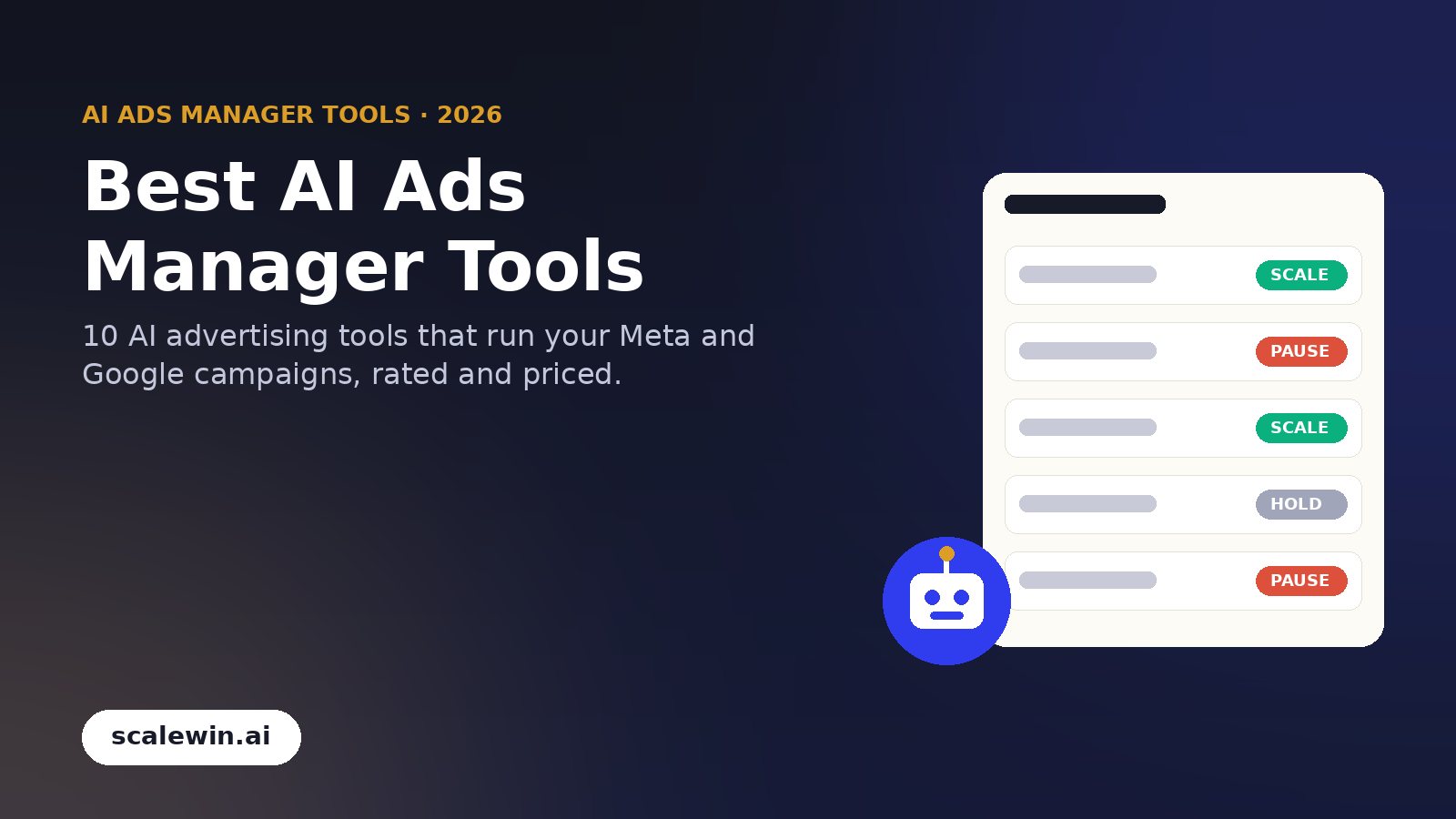
Search for AI advertising tools and you get two very different things mixed into one list: tools that make ads (image and copy generators) and tools that manage ads (automation, bidding, budget shifting, reporting). This article is only about the second kind, because that is where most ad budgets are won or lost.
The job of an AI ads manager is the daily grind a good media buyer does: read yesterday's numbers across every campaign, pause what has stopped working, add budget where return is holding, catch a creative that has fatigued, and explain the decision. A human does this well for 3 to 5 accounts. Software does it for hundreds, at 6 am, without forgetting.
We manage about ₹300 crore (roughly $36 million) of Meta and Google spend a year for D2C and service brands, and we have tested or used every tool below on real accounts. Each one gets our rating out of 5, the starting price as listed by the vendor in November 2026, and who it suits. Disclosure: ScaleWin, which publishes this blog, is on the list at number 4. We have marked it and kept the comparison honest.
1. Madgicx - the most AI automation per dollar for Meta ads
Madgicx sits on top of Meta Ads Manager and adds what Meta does not give you: an AI that audits the account every day, automation tactics you can switch on (stop-loss, scale winners, revive paused ad sets), audience launching from one screen, and a creative-insights view that tags your ads and shows which ones are carrying the account. Its "AI Marketer" summarises the day in plain language and proposes actions you approve with one click.
Why it is number one: for a Meta-heavy brand it covers the most ground for the least money, and the automation is pre-built, so you are not writing rules from scratch.
What to watch: it is Meta-only in practice (Google support is reporting, not management), and the interface has a lot going on. Give yourself a week before judging it.
2. Revealbot - write your own rules, across Meta, Google, TikTok and Snap
Revealbot is the rules engine. You define conditions ("if ROAS over the last 3 days is below 2 and spend is above $200, pause") and it checks them as often as every 15 minutes across Meta, Google, TikTok and Snapchat. It also has budget scheduling, bulk ad creation and Slack reporting.
Why it is on this list: when you know exactly what you want automated, nothing is more precise. Many agencies run their whole Meta operation on Revealbot rules.
What to watch: it only does what you tell it. There is no "AI figured this out" layer; a bad rule runs just as fast as a good one. Test every rule on one campaign first.
3. Optmyzr - the Google Ads optimisation suite agencies swear by
Built by ex-Googlers, Optmyzr gives you one-click optimisations (search-term negatives, bid adjustments, budget pacing, ad text suggestions), a rule engine, scripts, and a PMax insights view that shows what Google's own black-box campaigns are actually doing. It also covers Microsoft and Amazon Ads.
Why it is on this list: for Google, it is the most complete toolkit, and the PMax reporting alone justifies it for larger accounts.
What to watch: the price and the learning curve both assume an agency. A single brand with one account will use a fraction of it.
4. ScaleWin - Meta and Google in one dashboard, managed on profit, not ROAS
Full disclosure: this is our product. Read the entry with that in mind and judge it on the free trial.
ScaleWin connects to Meta Ads, Google Ads and your store, then does the daily review for you: which ad sets to pause, which to scale, where to move budget, which search terms to negate, which creative has fatigued. The difference from the tools above is the number it optimises for. It pulls product cost, shipping, payment fees, GST or VAT and returns, so every recommendation is based on net profit per campaign, not platform ROAS. Each morning you get a short report on WhatsApp or email; you approve, and it applies the changes. It also includes an Ad Spy view of competitor ads and an AI Creative Studio for new variations, so the whole loop sits in one place.
Why it is on this list: most brands do not have a ROAS problem, they have a "ROAS looks fine but the bank balance does not move" problem. Managing on profit fixes that.
What to watch: it is built for e-commerce and lead-gen brands, not for agencies juggling 50 clients, and it does not cover TikTok yet.
5. Opteo - Google Ads suggestions for one account, explained in plain English
Opteo watches your Google Ads account and surfaces improvements as cards: add this negative keyword, this ad has a low CTR, this keyword is spending without converting, this budget is capped. You read the reasoning, click to apply, and it is done in Google Ads. It also has budget alerts and performance monitoring.
Why it is on this list: it is the friendliest Google tool here. You learn why each change matters, which makes you a better buyer over time.
What to watch: Google only. And it suggests rather than acts, so someone still has to open it daily.
6. AdEspresso - the easy on-ramp for small Meta and Google budgets
AdEspresso simplifies campaign creation (split-test many headlines, images and audiences in one go), then uses automatic optimisation rules to shift budget toward the winners. It covers Meta and Google and has clean, client-friendly reports.
Why it is on this list: it is the gentlest way to start testing creatives at scale without learning Ads Manager's every corner.
What to watch: the AI is light. Serious buyers outgrow it and move to Madgicx or Revealbot within a year.
7. Smartly - enterprise creative automation and buying across every platform
Smartly combines dynamic creative generation (thousands of product variations from templates), cross-platform buying and AI budget allocation in one system. Big retailers and travel brands use it to run catalogue-scale advertising with a small team.
Why it is on this list: at enterprise scale nothing else automates creative and buying together as deeply.
What to watch: pricing starts in the thousands per month and onboarding takes weeks. Not for a growing brand.
8. Triple Whale - attribution first, with an AI analyst (Moby) on top
Triple Whale is a measurement platform: pixel-based attribution across Meta, Google, TikTok and email, a profit dashboard, and Moby, an AI you can ask questions like "which campaigns lost money last week after returns?" It does not change bids or budgets for you, but it tells you where the truth is.
Why it is on this list: an AI ads manager is only as good as the numbers it reads. If your attribution is broken, fix that first.
What to watch: it informs; it does not act. Pair it with a management tool, or with ScaleWin which has the profit layer built in.
9. Adzooma - free account health checks for Google, Meta and Microsoft
Adzooma links Google, Meta and Microsoft Ads, scores each account, and lists "opportunities" (wasted spend, missing extensions, budget issues) you can apply with a click. The free tier is generous, and paid tiers add automation rules and white-label reports.
Why it is on this list: it is the cheapest way to get a second pair of eyes on an account every week.
What to watch: the suggestions are generic compared with Optmyzr or Opteo, and the Meta side is thinner than the Google side.
10. Albert.ai - the fully autonomous buyer for large budgets
Albert is the original "self-driving" ads AI: give it goals, budgets and creative assets, and it runs the buying, audience discovery and allocation across Meta, Google and programmatic, continuously. Brands like Harley-Davidson dealerships made it famous.
Why it is on this list: it is the clearest example of where this category is heading, full autonomy with guardrails.
What to watch: enterprise pricing and onboarding, and you need enough data volume for the AI to learn. Below six figures a month it has little to work with.
The free AI inside Meta and Google (use it before you pay)
Both platforms now ship a lot of what paid tools used to sell. On Meta, Advantage+ sales campaigns automate audience, placement and budget split, and Advantage+ creative enhancements test variations of your assets. On Google, Performance Max and AI Max for Search do the same across Search, Shopping, YouTube and Display. They are free and they use first-party signals no third-party tool can see.
What they do not do is tell you why, compare across platforms, read your product costs, or stop spending when a campaign is profitable for Meta but not for you. That gap is exactly what the tools above fill. The honest rule: switch the native AI on, then pay for a manager only when it beats the native result by more than its fee.
How to choose: four questions
- Where is most of the spend? Meta-first: Madgicx or Revealbot. Google-first: Optmyzr or Opteo. Both, on a store: ScaleWin.
- Do you want suggestions or actions? Opteo, Adzooma and Triple Whale suggest; Madgicx, Revealbot, Albert and ScaleWin act (with approval settings).
- Which number do you manage to? If it is ROAS, most tools work. If it is profit after costs, you need a tool that knows your costs: ScaleWin, or Triple Whale paired with a manager.
- Who will open it? A tool nobody logs into does nothing. If that is your reality, prefer one that pushes a daily report to WhatsApp, Slack or email and asks for a yes/no.
Quick comparison
| Tool | Platforms | Acts or suggests | Optimises for | Our rating | Starting price |
|---|---|---|---|---|---|
| Madgicx | Meta (Google reporting) | Acts | ROAS / CPA | 4.4 | ~$55/mo |
| Revealbot | Meta, Google, TikTok, Snap | Acts (your rules) | Any metric you define | 4.2 | ~$99/mo |
| Optmyzr | Google, Microsoft, Amazon | Both | CPA / ROAS | 4.4 | ~$249/mo |
| Opteo | Suggests | CPA / CTR | 4.1 | ~$129/mo | |
| ScaleWin | Meta, Google (+ SEO) | Acts (with approval) | Net profit | 4.5 | $55/mo per channel |
| AdEspresso | Meta, Google | Acts (simple rules) | CPA | 3.8 | ~$49/mo |
| Smartly | Meta, Google, TikTok, Pinterest, Snap | Acts | ROAS at scale | 4.0 | Enterprise |
| Triple Whale | All (measurement) | Suggests | Attribution / profit | 4.1 | Free, ~$129/mo paid |
| Adzooma | Google, Meta, Microsoft | Suggests | Account health | 3.7 | Free |
| Albert | Meta, Google, programmatic | Acts (autonomous) | Goal you set | 3.9 | Enterprise |
Ratings are our opinion after using each tool on client or test accounts, weighted for how much daily work it removes, how clearly it explains decisions, and value for money. Prices are as listed by each vendor in November 2026 and change often; check the vendor's page before buying.
- Meta / Instagram Ads Cost Calculator - Instagram ads cost about $18.23 per 1,000 impressions and $1.46 per click in November 2026
- Google Ads Cost Calculator - Google Ads cost averages $5.42 per click and $66.69 per lead in 2026
- Snapchat Ads Cost - Snapchat ads cost from $5 a day
Key takeaways
- Separate "AI that makes ads" from "AI that manages ads"; this list is the second kind, and that is where budgets are saved or lost.
- Meta-first: Madgicx or Revealbot. Google-first: Optmyzr (agencies) or Opteo (one account). Both on a store: ScaleWin.
- Switch on Advantage+ and Performance Max first; a paid tool must beat the free native AI by more than its fee.
- Decide whether you want suggestions or actions, and which number the tool optimises for; ROAS and profit can point in opposite directions.
- Run a two-week on/off test on the same budget before committing to an annual plan.
AI ads manager tools: frequently asked questions
What is an AI ads manager?
Which AI is best for Facebook and Instagram ads?
Which AI tool is best for Google Ads?
Can AI run my ads fully on its own?
Are these tools worth it for small budgets?

Ajay is the founder of ScaleWin. He works hands-on with Meta Ads, Google Ads and SEO for Indian D2C and service brands, and built ScaleWin so that the daily work of a performance marketer - reading numbers, pausing losers, scaling winners - happens automatically.
Drafted with AI assistance. How these articles are written
Try an AI ads manager that works on profit
ScaleWin reviews your Meta and Google accounts every morning, recommends what to pause, scale and fix on real profit after costs, and applies it with one approval. 2 days free on your own data, no card needed.
Start free, no card